IFOMPT Webinars
IFOMPT hosts up to six webinars per year with the purpose of sharing knowledge and exposing our Member Organisations, Associate Member Organisations and Registered Interest Groups to renowned presenters from around the world. Webinars are attended at a small attendance fee and the income is used to further enhance the objects of IFOMPT. The webinars are recorded and are available a library hosted by APTA on a user-pay basis following the live events.

Note that APTA membership is not required to access the webinars, but you do need to set up an APTA ID – there is no cost for that. Simply go to https://learningcenter.apta.org/IFOMPT in order to register. For easy access to the specific recordings you can also click on the link below the photograph of each presenter in the IFOMPT Webinar Hall of Fame once you have an APTA account.
Any recommendations about potental presenters are most welcome and can be sent to admin@ifompt.org.
IFOMPT Webinar Hall of Fame
We have been honoured to have highly respected presenters involved in our webinars and acknowledge their contribution to reaching the IFOMPT objective of sharing knowledge for the advancement of OMPT practice worldwide.



List of Webinars
Jean-Sebastien Roy Rotator Cuff-Related Shoulder Pain in 2026: Key Insights for Clinicians and Patients
A session to gain insights on Rotator Cuff- Related Shoulder Pain that you can immediately apply in your setting.
Jean-Francois Esculier Patellofemoral Pain - Mythbusting Based on the Latest Evidence
This webinar will look at what is new and share information on patellofemoral pain. It will cover 5 myths and will aim to assist you in answering the following questions from your patients: Why is this happening to me? and How do we fix it?
Dr Erik Thoomes Diagnosis and Management of Patients with Painful Cervical Radiculopathy - Considerations for the Orthopaedic Manual Physiotherapist
After this webinar, you will be familiar with a definition of what a painful cervical radiculopathy is, you will be familiar with the course and prognosis for a patient with a painful cervical radiculopathy and be able to differentiate patients with neck pain and radiating arm pain and their potential other causes. Additionally, you will be familiar with the scope of potentially effective treatment modalities and with the evidence supporting or negating proposed treatment modalities, allowing you to compose an individualised and staged, patient-specific management plan for patients with a painful cervical radiculopathy.
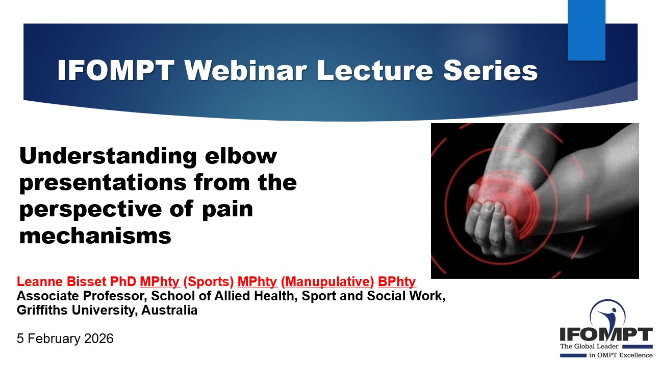
Leanne Bisset Understanding elbow presentations from the perspective of pain mechanisms
This webinar by Dr Leanne Bisset will be all about getting a grip on lateral elbow pain.
Dr Bisset will be taking a deep dive into elbow pain from a perspective of pain mechanisms bringing together research and clinical practice elements.
She will look at:
- Lateral elbow pain – differential diagnosis
- Nociceptive, neuropathic, nociplastic pain
- Case-based clinical reasoning.
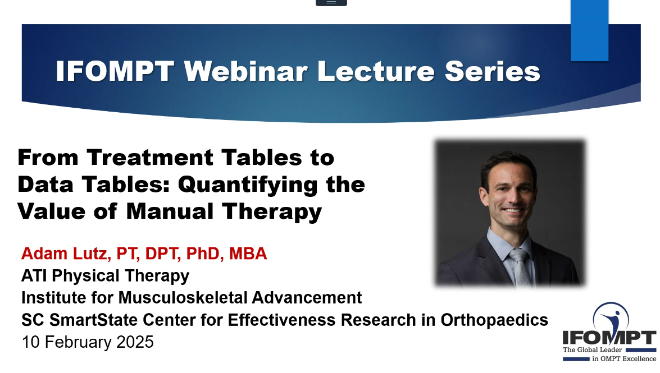
Adam Lutz From Treatment Tables to Data Tables: Quantifying the Value of Manual Therapy
Join Dr. Adam Lutz as he explores the intersection of clinical expertise and data-driven insights in manual therapy. As a health services researcher and clinician with extensive experience in manual therapy, Dr. Lutz leverages large patient registries to evaluate the effectiveness of musculoskeletal care delivery and challenge conventional paradigms. Drawing from his work in Spine Journal, he will examine how high-performing clinicians dynamically tailor their approach—balancing manual therapy and exercise-based interventions in response to patient complexity. He will also explore the evolving role of manual therapy, the challenges of demonstrating its value in physical therapy outcomes research, and the profound impact of therapist and patient beliefs on clinical success.
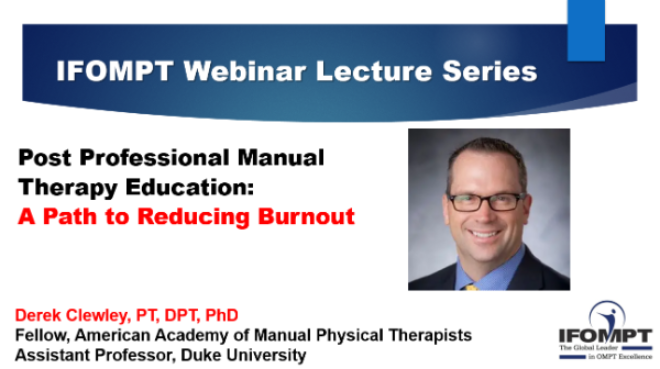
Derek Clewley Post professional manual therapy education: A path to reducing burnout
Burnout is an increasing challenge in the profession of physical therapy, leading to exhaustion, disengagement, and reduced productivity. This talk will risks and impacts of burnout, and provide strategies for addressing it through professional development. We’ll discuss how continuous learning, skill enhancement, and career growth can be powerful tools for regaining motivation and resilience. Join us for this insightful session and take the first step toward a healthier, more fulfilling professional journey!
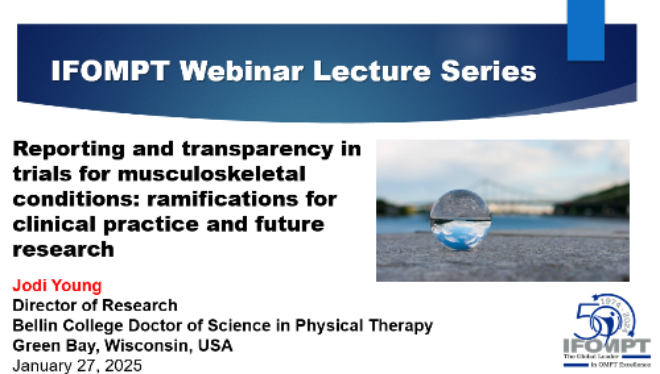
Jodi Young Reporting and transparency in trials for musculoskeletal conditions: ramifications for clinical practice and future research
Reporting guidelines are available for use by authors when writing up the results of musculoskeletal research, including manual therapy and exercise therapy research. However, many publications fail to appropriately report specifics on the methodology used or the interventions provided, which creates potential issues with the actual treatment effects reported. This webinar will highlight the current state of the musculoskeletal literature in relation to reporting and transparency.
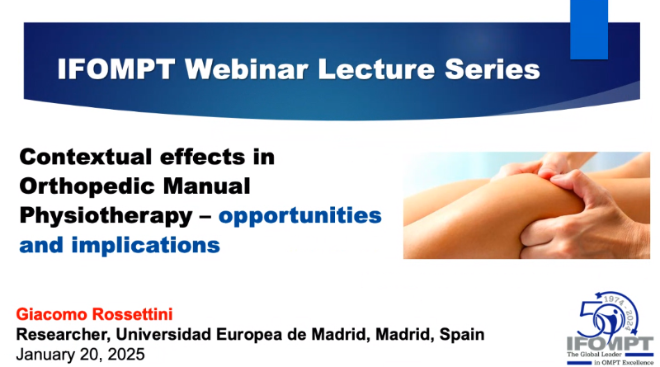
Dr Giacomo Rossettini Contextual effects in Orthopedic Manual Physiotherapy – opportunities and implications
Contextual effects are embodied psycho-neurobiological phenomena capable of inducing changes across neurobiological, physical, perceptual, and cognitive levels. These changes are triggered by various contextual factors present in the therapeutic environment, represented by diverse healing rituals and signals (e.g., the clinician’s attributes, the patient’s characteristics, the patient-clinician relationship, treatment features, and the broader healthcare setting).
Evidence has shown that contextual effects can influence subjective outcomes in musculoskeletal patients, often through placebo and nocebo mechanisms. A positive context enhances therapeutic outcomes through placebo effects, while a negative context can worsen clinical conditions by inducing nocebo effects.
Moving from this premise, the webinar aims to provide a comprehensive overview of contextual effects by examining:
- Reasons for Interest;
- Definitions and Dimensions;
- Mechanisms of Action and Impact on Outcomes;
- Implications for Practice and Research.
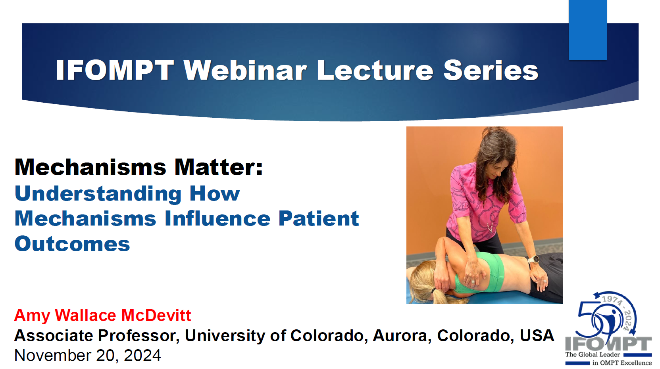
Dr Amy McDevitt Mechanisms Matter: Understanding How Mechanisms Influence Patient Outcomes
Session Objectives
- Define key concepts of mechanisms in manual therapy, including biophysiological, neurophysiological, and non-specific effects.
- Differentiate between mechanistic research and clinical trials, focusing on methodology, outcomes, and relevance to practice.
- Explain how contextual factors, such as patient expectations and therapeutic alliance, influence clinical outcomes.
- Discuss how understanding mechanisms of manual therapy can address gaps in research and inform tailored, evidence-based clinical practice.
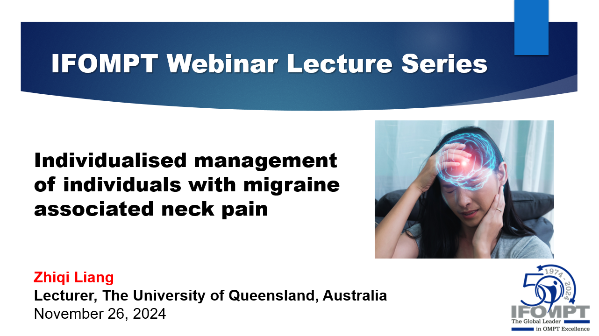
Dr Zhiqi Liang Individualised management of individuals with migraine associated neck pain
An overview of the current body of literature on physiotherapy management of migraine will be provided, with emphasis on neck treatments and mechanisms relating to neck pain and migraine. Current evidence indicates that patients with neck pain and migraine have different underlying mechanisms. Subgroups with different treatment directions are present. Therefore, this session will discuss on an individualised approach to assessment and management of patients with migraine and neck pain. A case scenario will be discussed to illustrate these concepts.
Dr Damian Keter The winds of change: Modernizing manual therapy rationale, application, and education
Where is manual therapy going looking forward based on the changes we are seeing within the profession? What manual therapy is and perhaps is not doing when we put our hands on a patient.
This webinar will:
- Discuss the proposed treatment mechanisms occurring with manual therapy including the shift away from emphasis on biomechanical rationale for treatment effects.
- Discuss how the above influence how candidates for manual therapy should be identified.
- Discuss how manual therapy training paradigms can be modernized to appreciate the above factors moving forward.
Dr Kathryn Schneider Updates from the Amsterdam International Consensus on Concussion in Sport
Kathryn will share updates from the Amsterdam International Consensus on Concussion in Sport and provide tips to help in the management of concussion in your clinical practice.
Dr Firas Mourad A guide to identify cervical autonomic dysfunctions (and associated conditions) in patients with musculoskeletal disorders in physical therapy practice
Differential diagnosis is a hot topic in physical therapy, especially for those working in a direct access setting dealing with neck pain and its associated disorders. All international guidelines agree in recommending to first rule out non-musculoskeletal pathologies as the cause of signs and symptoms in the patient. Although the autonomic nervous system (ANS) has a crucial role and is also involved in pain conditions, coverage of it in neuroscience textbooks and educational programmes is limited and most healthcare professionals are unfamiliar with it. Although autonomic conditions are benign in nature, they are clinically of great importance as they may be a ‘red flag’ warning of an injury along the sympathetic pathway. Therefore, sound knowledge of the ANS system is essential for clinicians. Gaining knowledge and understanding of the ANS, its function, its dysfunction, and the related clinical manifestations is likely to lead to a decision-making process driven by ‘science and conscience’. This will empower physical therapists to be aware of subtle clues that may be offered by patients during the interview and history intake leading to the appropriate physical examination and triage.
Learning outcomes: To develop physical therapists’ knowledge of and confidence in understanding cervical ANS function and dysfunction, thus enhancing clinical reasoning skills and the pattern recognition process, and performing and interpreting objective examinations.
Dr Mary O'Keeffe Diagnostic labels for musculoskeletal pain – Weighing benefits against harms
Mary O’Keeffe is one of the keynote speakers at the IFOMPT 50th Celebration Conference in Basel in July 2024 where she will present on “Innovative models of care in musculoskeletal and manual physical therapy”. This webinar talks to her conference topic and covers Diagnostic labels for musculoskeletal pain – Weighing benefits against harms. She will discuss research around diagnostic labels for musculoskeletal pain. The goal of this presentation is to get clinicians and academics alike thinking and reflecting about the potential benefits and harms of using different language and labels with our patients.
Maria Brugner Seewald Microinstability of the hip joint – does it even exist? Part 1 Theory and background Part 2: Patient case example and management
The hip joint is considered an inherently stable joint due to its bony shape and tight ligamentous structures. Nevertheless, morphological changes (dysplasia, cam / pincer morphology for example), as well as reduced integrity of passive structures (e.g. labral lesions) or lack of motor control are described in the literature to have the potential to lead to microinstabilities (MI).
MI is also discussed as a contributor to the development of hip osteoarthritis over a prolonged period of time, therefore recognition and appropriate management is crucial.
René Bakodi Non-specific Neck Pain and Stability: Beyond Chin Tuck - Exploring Functional Rehabilitation and Evidence-based Management
Non-specific neck pain is a common problem among patients seeking help in physical therapy clinics. This webinar will review examination steps to distinguish between functional and structural instability as well as identify and interpret muscular deficits.
Current literature on active stabilization and strengthening of the cervical spine will be presented and critically reviewed. In addition, a strengthening program (The Glory Nine) will be presented which has already shown excellent results in terms of pain reduction and functional improvement in a pilot study.
Neuropathic pain: Clinical assessment and relevance for management
This webinar will cover aspects relating toWhat is neuropathic pain?
- An explanation for why not all nerve pain is neuropathic
- Clinical assessment of neuropathic pain
- Consequences for management
Prof Schmid will provide snippets on translating the neuroscience all the way from the bench to the bedside and provide ideas on how to make sense of complex patient presentations of patients with nerve pain.
Dr Anthony Demont Assessment, triage, and physiotherapy care of patients with cervicogenic headache, migraine, and tension-type headache
Headache is a clinical symptom and is one of the most common disorders of the nervous system in the population. It is a painful and disabling manifestation that can be triggered by a primary cause (migraine, tension-type headache, cluster headache…) or secondary (attributed to the neck, vascular disorders…). This symptom is a frequent reason for consultation in primary care. Varying considerably from one region of the world to another, headache disorders are considered a public health issue in terms of disability and financial cost to society. Headaches impact all dimensions of the patient’s life (personal and professional) and contribute to strongly modify behaviours such as the constant apprehension of the next painful episode. The understanding of headache and the mechanisms of chronicisation have greatly evolved in the scientific literature and therefore condition the use of evidence-based practices to provide treatments personalised to the patient’s health status. This webinar aims at understanding the assessment, referral choices and treatments that can be provided to patients consulting for prevalent types of headache including tension-type headache, migraine, and cervicogenic headache.
Richard Rosedale When is an extremity problem not an extremity problem?
Many times a day, in our clinical practice we go through the process of ‘screening the spine’ for an isolated extremity problem. We may ask about spinal pain/history and look at spinal range of motion or maybe palpate the spine. Often, after a quick check we move onto the extremity: we’ve ‘cleared the spine’. But how sure are we that this is the case? On what are we basing this daily decision? If the spine is implicated, will there always be spinal pain? loss of range? production of extemity pain on palpation? On what are we basing these decisions? Research, clinical experience or assumptions?
For such a critical clinical area that can dictate our ongoing focus of management, unfortunately, the research is lacking and assumptions abound. Clinical experience will only get us so far, as for many, once we have ‘cleared the spine’ the extremity becomes the focus and the spine is never revisited.
This presentation will be exploring some provisional data which suggests that isolated extremity pain is quite commonly ‘coming from the spine’ and we have some indicators that help us predict if this is likely to be the case.
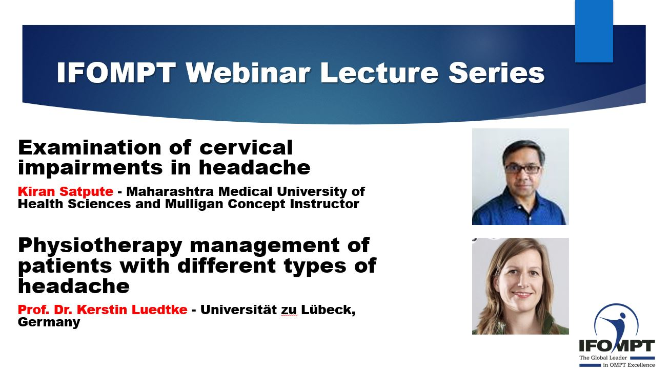
Drs Kiran Satpute and Kerstin Luedtke Management of Patients with Headache
Dr Kiran Satpute who is an under- and post graduate lecturer at the Physiotherapy College affiliated to Maharashtra Medical University of Health Sciences in India and a Mulligan Concept Instructor will start the presentation looking at: Examination of cervical Impairments in headache
Physiotherapists are often involved in the management of various forms of headache including cervicogenic headache, migraine and tension type headache. In part this is due to presence of neck pain in these patients. However, the presence of neck pain in headache is not necessarily associated with cervical musculoskeletal dysfunction. A lack of musculoskeletal dysfunction suggests treatment to the cervical spine is unlikely to be helpful. Thus the role of the physiotherapist is to accurately identify the presence of neck musculoskeletal dysfunction, relate this information to headache symptoms and use the assessment findings to build a rationale for physiotherapy management.
Kerstin Luedtke, a physiotherapist and a Professor for Physiotherapy at the University of Lübeck in Germany, will then proceed discussing: Physiotherapy management of patients with different types of headache
The presentation will focus on the pathophysiology and the management of primary headache, and specifically migraine and cervicogenic headache and tension-type headache. It will give an insight into the management and diagnostic procedures for patients with migraine and headache. This will include discussing effective interventions.
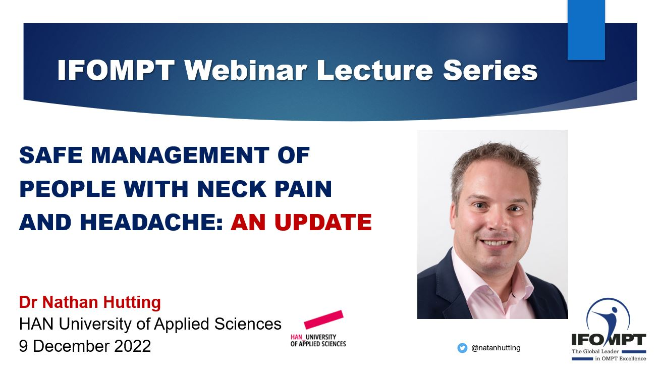
Dr Nathan Hutting Safe Management of People With Neck Pain and Headache: An Update
Neck pain is a highly prevalent condition that can lead to considerable pain, disability and economic costs. Cervical spine manipulation and mobilisation are frequently used in the management of neck pain and headache. Although very rare, serious adverse events following cervical spine treatment have been described in literature. The current hypothesis regarding these serious adverse events is that patients presenting with neck pain and headache who go on to develop a serious adverse event, such as a dissection, have an underlying pathology which is subsequently aggravated by treatment.
Neck pain, headache, and/or orofacial symptoms are potentially often the first symptoms of an underlying vascular pathology (e.g. craniocervical artery dissection) or blood flow limitation. To identify a underlying vasculogenic contribution, physiotherapists and other musculoskeletal clinicians should have up-to-date knowledge about risk factors, signs and symptoms and should be able to perform a contemporary subjective and objective examination and clinical reasoning process. The IFOMPT Cervical Framework guides clinicians to assess the cervical spine for potential vascular pathologies before planning interventions. However, evidence suggests that musculoskeletal clinicians’ knowledge and skills regarding the identification of an underlying vasculogenic contribution to the patient’s complaints can be improved. Therefore, a contemporary approach regarding safe management of people with neck pain and headache will be presented in this IFOMPT webinar.
Prof Jeremy Lewis Reframing how we care for people living with persistent MSK pain
Why do we need to change our direction?
- We are not being honest with people seeking care.
- We are prioritising low-value and high-cost procedures on an industrial scale.
- The provision of healthcare is inequitable and unsustainable.
How as a profession can we provide better care to the communities we are serving?